When the Calling Card Came Before the Conversation
Calling cards announced a visit without demanding entry. Learn how to read the card, the setting, and the response to understand the social signal.
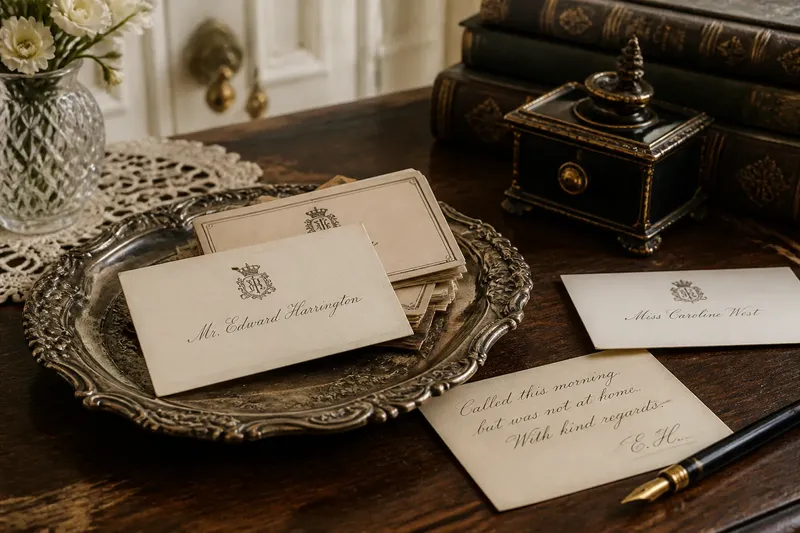
What did a calling card mean when it arrived before a conversation? In some formal visiting customs of the nineteenth and early twentieth centuries, a card identified a caller and announced an attempted visit without requiring the household to receive them. Its meaning depended on where it was left, who sent it, and what followed.
The card made a social approach visible while leaving the next move open. A card presented at the door was different from one left when the recipient was absent, and neither necessarily meant the caller was a friend or had been invited. The custom varied by place, period, and social circle, so the surrounding details matter more than any single universal rule.
Unexpected visits
A caller arriving without an appointment could offer a card before asking to be admitted. The household then had a chance to decide whether to receive the visitor, defer the meeting, or decline. The exchange separated the announcement from entry: being at home did not necessarily mean being available.
That pause could soften an abrupt arrival, though it did not remove social pressure. The visitor had made an approach, and the recipient still had to choose how to answer. The card recorded the caller’s identity; it did not confer a right to enter.
First introductions
For someone not yet acquainted with the recipient, a card could provide a name and, depending on the card and its setting, a title or affiliation. It offered a restrained way to make an introduction without acting as if familiarity already existed.
If a mutual acquaintance had suggested the call, that connection might be conveyed separately. The card identified its owner, but it could not speak for the person who made the introduction or promise that the recipient would welcome a meeting.
Courtesy calls
Between people who already knew one another, leaving a card could acknowledge a brief visit or maintain contact when no conversation took place. The gesture might mark a courtesy, but its meaning depended on the relationship and local expectations.
Say a fictional visitor stops by a neighbor’s home while the neighbor is out and leaves a card with a short note. The neighbor can identify who called and decide later whether to send a message or return the visit. The observable result is an acknowledged attempt without a forced face-to-face meeting.
Sympathy and thanks
A card could also accompany sympathy or thanks, allowing someone to acknowledge an occasion without requiring an immediate conversation. After a bereavement, for instance, a brief written message could express regard while leaving the recipient free to respond later, or not at all.
The form was not a substitute for every kind of support. A close friend might choose a more personal gesture, while a formal acquaintance might use a card as a respectful opening. The suitable response depended on the relationship and the recipient’s circumstances.
Return visits
A recipient might answer a call with a visit or another card. Such a reply signaled that the first gesture had been noticed, though reciprocity did not require an identical response. A brief call could be answered with a card, depending on the reason for the visit and the relationship between the people involved.
When interpreting a historical account, distinguish the direction of the exchange. A card brought to the door could announce an approach; one left behind might record a missed meeting; a later card could be a reply. The sequence helps clarify whether the object began contact, acknowledged it, or returned it.
Formal visiting customs
In some formal social circles, calling cards were part of conventions for arranging visits and managing access to a home. Practices differed across regions, periods, and households; visiting hours and the handling of cards were not universal customs. A particular account is best read in its own setting rather than treated as a rule for everyone who used calling cards.
These rituals could reflect distinctions of rank, gender, and social standing. Their politeness did not make them equal or open to all. A card could make a visitor recognizable while leaving the household in control of whether a meeting took place.
For historical interpretation, look at the people and place as well as the object. A card mentioned in a formal household scene may carry different implications from one exchanged among acquaintances. Avoid assuming that a single card practice applied across all communities or eras.
Limits of the card
A calling card could identify its owner and signal that a visit had been attempted, but it could not reliably explain a complicated request or convey the nuance of a close conversation. A note could add context, though that made the message more explicit than a bare card.
Consider the circumstances: who sent it, where it was left, whether a visit was expected, and what happened afterward. A card alone does not establish friendship, courtship, business, or obligation. It is an opening signal, not a complete account of the relationship.
What did a calling card signal?
Did a calling card mean the caller was invited?
No. It could announce an attempted visit, but it did not establish that the household had invited the caller. The recipient still had a say in whether to receive or decline them.
Was leaving a card the same as meeting someone?
No. A card left when the recipient was away acknowledged the attempt without creating a face-to-face exchange. A conversation might follow later, but the card itself did not make that happen.
Could a calling card carry a personal message?
A card could be accompanied by a short note, while longer or more intimate matters generally called for a letter or direct conversation. The note’s contents and the surrounding custom would shape how the gesture was understood.
Did calling-card customs work the same everywhere?
No. Their use differed by time, place, and social circle. When reading a particular account, look for clues about the household and its conventions before drawing conclusions.
Reading the exchange
To interpret a calling card, begin with the practical details: who sent it, where it was left, and whether the recipient was present. Then consider the relationship and any response, such as a return visit, note, or later meeting. Those clues help distinguish an introduction from a courtesy or a reply.
Calling cards gave uncertainty a form that could be acknowledged without settling everything at once. A visitor could make an intention visible without insisting on conversation, while the recipient could decide what response, if any, suited the situation. For anyone reading an old account, the most useful clue is often what happened next: the card opened the exchange, but the people involved determined whether it continued.